KEY THEMES
- Executive Summary
- The Emerging Operational Problem
- Why Existing AI Workflows Become Structurally Fragile
- The Constitutional Stack Framework
- Constitutional Separation & Operational Stability
- Operational memory becomes structurally preserved through:
The Constitutional Stack Continuity, Governance & Survivability in AI-Assisted Systems
Executive Summary
Artificial intelligence is rapidly evolving from isolated conversational tooling into persistent operational infrastructure.
Across industries, organisations are increasingly integrating AI systems into development workflows, operational environments, knowledge management systems, delivery pipelines and decision-making processes. The result is a new category of operational environment — one where intelligence is no longer temporary, but persistent, interconnected and increasingly autonomous.
Yet while capability has accelerated rapidly, governance infrastructure has not evolved at the same pace.
Most AI-assisted systems today remain structurally fragile. They rely heavily on temporary conversational context, fragmented operational memory and loosely governed workflows. As systems scale, this creates increasing instability across continuity, validation, operational clarity and survivability.
The Constitutional Stack was created in response to this emerging problem.
Rather than approaching AI purely as a capability layer, the Constitutional Stack approaches AI-assisted systems as operational environments requiring constitutional structure.
The framework introduces a specialised operational architecture designed to preserve:
continuity, validation, governance, operational memory, survivability, and human operational clarity
across long-running AI-assisted workflows.
This paper outlines the operational risks emerging within modern AI environments, explains why existing approaches frequently become structurally unstable over time, and presents the Constitutional Stack as an operational infrastructure model designed to address those risks.
The objective is not to slow intelligence systems down.
The objective is to ensure they remain governable, understandable and operationally survivable as they evolve.
The Emerging Operational Problem
Most AI discussions continue to focus on capability.
How powerful are the models? How autonomous can workflows become? How much labour can be automated? How rapidly can systems scale?
These are important questions, but they are increasingly incomplete.
As AI systems move deeper into operational environments, a different category of problem begins to emerge — one less concerned with intelligence itself and more concerned with operational coherence over time.
Projects begin fragmenting across disconnected conversations. Context becomes difficult to reconstruct. Validation pathways weaken. Operational assumptions disappear. Escalation becomes inconsistent. Humans gradually lose visibility into why decisions were made, whether outputs remain trustworthy and how systems arrived at operational conclusions.
Initially these issues appear manageable.
During early adoption phases, AI-assisted workflows often feel highly productive. Teams move faster. Documentation appears easier to generate. Automation reduces friction. Output increases significantly.
The instability emerges later.
Across longer timelines. Across multiple contributors. Across multiple sessions. Across increasingly layered operational systems.
The problem is not usually catastrophic system failure.
It is operational fragmentation.
A slow erosion of continuity across increasingly intelligent systems.
This fragmentation creates a new category of organisational risk.
Systems become operationally difficult to govern precisely because they appear operationally successful.
The faster environments accelerate, the harder they become to reconstruct, validate and stabilise.
Many organisations have already experienced early versions of this phenomenon:
duplicated reasoning across disconnected systems, contradictory operational outputs, undocumented assumptions, incomplete validation, unclear escalation ownership, fragmented decision trails, and growing cognitive fatigue among human operators.
These are not isolated implementation problems.
They are structural continuity problems.
And they become more significant as intelligence systems become more persistent, interconnected and autonomous.
Why Existing AI Workflows Become Structurally Fragile
Most current AI workflows still operate primarily through conversational context.
This model works reasonably well for isolated interactions. It becomes increasingly fragile once systems begin operating across longer operational timelines.
Conversations are inherently temporary.
They drift. They fragment. They disappear. They lose operational traceability over time.
Yet many AI-assisted workflows still depend heavily on temporary conversational reconstruction as their primary continuity mechanism.
This creates several structural weaknesses.
First, operational memory becomes inconsistent. Important assumptions, decisions and escalation pathways frequently remain trapped inside fragmented conversational history rather than preserved as durable operational infrastructure.
Second, validation becomes difficult to audit. Systems may generate convincing outputs without preserving sufficient evidence trails explaining how operational conclusions were reached.
Third, governance remains reactive rather than architectural. Escalation often occurs only after instability becomes visible rather than existing as part of the operational structure itself.
Fourth, human operators become cognitively overloaded. As systems become increasingly layered, humans gradually lose operational orientation across growing volumes of summaries, dashboards, agents and disconnected outputs.
These problems compound together.
The more capable systems become, the more damaging fragmentation becomes.
This is particularly important because most failures within AI-assisted environments are unlikely to emerge from model capability limitations alone.
They will emerge from continuity collapse.
From systems becoming:
too fragmented to understand, too accelerated to govern, too operationally dense to safely manage, and too disconnected to reliably validate.
The Constitutional Stack approaches AI-assisted environments from a fundamentally different perspective.
Rather than treating intelligence as the primary architectural concern, it treats operational survivability as the primary architectural concern.
This distinction reshapes the entire system design philosophy.
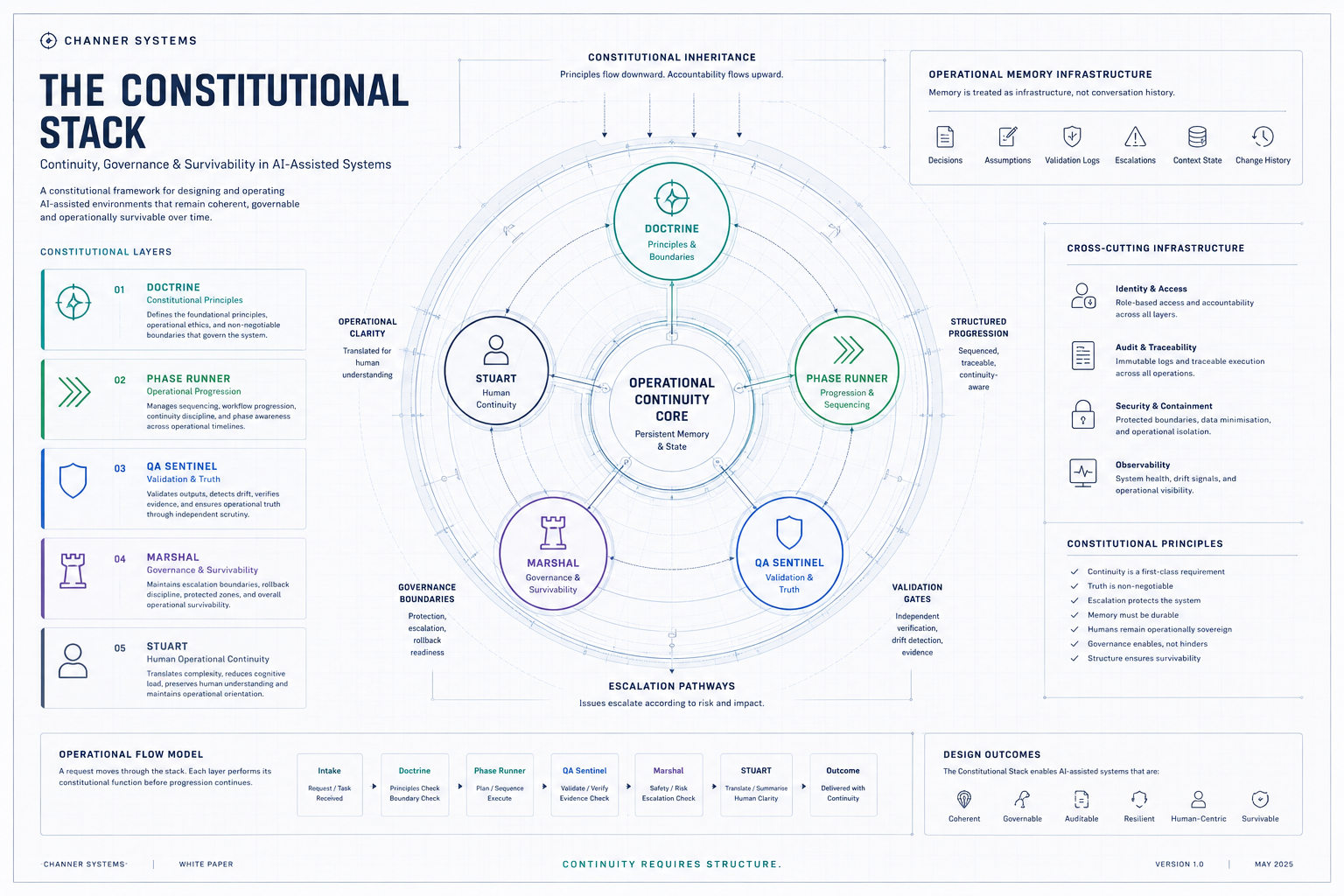
The Constitutional Stack Framework
The Constitutional Stack is an operational framework designed to introduce constitutional structure into AI-assisted systems.
Its purpose is not to maximise autonomy.
Its purpose is to preserve operational coherence.
The framework separates operational responsibilities into specialised constitutional layers, each designed to perform a distinct operational role.
This separation is intentional.
Progression should not govern validation. Validation should not control governance. Governance should not become invisible. Human continuity should not disappear beneath operational density.
The stack therefore establishes distinct operational layers with clearly separated responsibilities.
At the foundation sits Doctrine.
Doctrine defines the constitutional principles governing the system itself. These principles include continuity preservation, operational honesty, governance discipline, survivability awareness and human sovereignty.
Above Doctrine operates Phase Runner.
Phase Runner governs operational progression. It structures sequencing, maintains continuity discipline, preserves phase awareness and ensures operational workflows remain traceable over time.
QA Sentinel exists separately from progression.
Its role is to validate operational truth through evidence, drift detection and verification discipline. QA Sentinel is intentionally sceptical. It exists to ensure systems do not silently overclaim completion or stability.
Marshal governs survivability.
Marshal introduces escalation boundaries, rollback discipline, governance enforcement and protected operational zones. Rather than maximising acceleration, Marshal preserves operational containment and survivability.
Finally, STUART preserves human operational continuity.
As systems become increasingly layered and cognitively dense, STUART exists to reduce fragmentation for human operators. STUART translates operational complexity into understandable continuity without weakening governance meaning or operational truth.
Together these layers form a constitutional operational architecture.
Not a collection of AI personalities.
A behavioural infrastructure model.
Constitutional Separation & Operational Stability
One of the most important design principles inside the Constitutional Stack is constitutional separation.
No layer controls everything.
This is not simply an architectural preference. It is a survivability mechanism.
Many operational failures occur because progression, governance, validation and operational interpretation become merged together inside a single system or authority structure.
The Constitutional Stack intentionally separates these concerns.
Phase Runner asks:
- “What happens next?”
QA Sentinel asks:
- “Is that actually true?”
Marshal asks:
- “Is this safe to proceed?”
STUART asks:
- “What actually matters here?”
This separation creates operational tension.
Importantly, that tension is healthy.
Progression without validation becomes reckless. Validation without progression becomes paralysis. Governance without human clarity becomes organisational fatigue. Human continuity without governance becomes operational illusion.
The Constitutional Stack therefore treats operational disagreement as structurally valuable.
Not as instability.
This allows systems to remain operationally disciplined even as complexity increases.
Rather than centralising intelligence, the stack distributes operational responsibility across specialised constitutional layers.
This dramatically improves:
auditability, operational traceability, governance visibility, rollback discipline, and survivability awareness. Operational Memory As Infrastructure
Perhaps the most important idea within the Constitutional Stack is the treatment of memory as infrastructure rather than conversational residue.
Operational continuity cannot depend entirely on temporary interaction.
Long-running systems require persistent operational state.
This includes preserving:
assumptions, decisions, escalation history, validation records, rollback awareness, governance conditions, unresolved risks, and implementation chronology
across time.
The Constitutional Stack therefore treats continuity as a first-class operational requirement.
Operational memory becomes structurally preserved through:
repo memory, structured documentation, validation logs, decision records, governance notes, continuity timelines, and operational history systems.
This allows environments to survive:
interrupted sessions, contributor turnover, infrastructure evolution, long-running delivery cycles, and increasingly persistent AI-assisted workflows.
The importance of this principle becomes more apparent as systems scale.
Without durable continuity infrastructure, organisations eventually become dependent on reconstructing operational history manually across fragmented systems and disconnected conversational environments.
This becomes operationally unsustainable.
Continuity therefore evolves from convenience into infrastructure.
The Constitutional Stack treats that transition as architectural rather than optional.
Governance & Survivability
Governance within AI systems is often treated as a secondary operational concern.
Something added after capability already exists.
This model becomes increasingly dangerous once AI systems begin interacting with:
production environments, financial systems, deployment infrastructure, persistent operational memory, and protected organisational workflows.
The Constitutional Stack therefore treats governance as architectural.
Marshal exists specifically to preserve operational survivability.
Its purpose is not obstruction. Its purpose is containment, escalation discipline and rollback awareness.
Marshal governs:
protected operational zones, escalation requirements, deployment survivability, rollback discipline, operational containment, and governance boundaries.
Importantly, Marshal operates calmly.
It does not introduce theatrical restriction or arbitrary bureaucracy.
Instead it continuously evaluates:
operational reversibility, survivability consequences, rollback readiness, and governance integrity.
This distinction is critical.
Most operational collapses occur gradually rather than dramatically.
They emerge through accumulated shortcuts, weakened escalation discipline and invisible governance drift over time.
Marshal exists to prevent that gradual erosion before instability becomes structural.
Human Operational Continuity
One of the least discussed consequences of advanced AI-assisted systems is cognitive fragmentation.
As systems become increasingly intelligent, humans increasingly struggle to maintain operational orientation across expanding operational density.
Too many systems. Too many summaries. Too many workflows. Too many operational signals.
This creates environments that appear operationally advanced while becoming increasingly difficult for humans to safely manage.
STUART exists specifically to address this problem.
STUART is not a governance authority or validation system.
STUART preserves human continuity.
Its role is to:
reduce cognitive load, compress operational density, maintain continuity understanding, prioritise attention, and preserve calm operational clarity.
Importantly, STUART does not dilute truth.
It translates complexity without weakening operational meaning.
This distinction becomes increasingly important as organisations adopt persistent AI-assisted workflows across larger operational environments.
The future challenge facing many organisations will not simply be whether AI systems are intelligent.
It will be whether humans can remain operationally oriented inside increasingly intelligent systems.
The Constitutional Stack treats human continuity as infrastructure rather than interface design.
Strategic Implications
The Constitutional Stack should not be viewed as a finished system.
It is foundational operational infrastructure.
Its broader significance emerges as AI systems evolve beyond isolated interaction into persistent operational environments.
Future systems will likely become:
more interconnected, more memory-aware, more autonomous, more persistent, and increasingly embedded inside operational decision-making environments.
As this occurs, constitutional structure becomes increasingly necessary.
Without continuity infrastructure, systems fragment. Without governance architecture, acceleration destabilises operations. Without validation separation, operational truth becomes unreliable. Without human continuity layers, organisations become cognitively overloaded.
The Constitutional Stack proposes an alternative direction.
Not unrestricted autonomy.
But governed operational intelligence.
Systems capable of preserving:
continuity, operational memory, validation discipline, survivability, governance clarity, and human operational orientation
across time.
This represents a different way of thinking about AI-assisted environments.
Not simply as tools.
But as operational systems requiring constitutional structure.
Conclusion
The future of AI-assisted systems will not be defined solely by capability.
It will be defined by whether intelligence remains operationally survivable over time.
The Constitutional Stack was created around this principle.
That continuity matters. That governance matters. That validation matters. That memory matters. That human clarity matters.
As AI systems become increasingly persistent and operationally integrated, organisations require more than acceleration.
They require constitutional infrastructure capable of preserving operational coherence across evolving systems.
The Constitutional Stack is an early exploration of what that infrastructure may become.
Calm. Structured. Governed. Persistent.
Because continuity requires structure.
Continuity Requires Structure
The future of AI-assisted systems will not be defined by capability alone, but by whether intelligence remains governable, understandable and operationally survivable over time. Explore the Constitutional Stack and the emerging infrastructure behind continuity-first AI environments.